Key Ideas of Australian Democracy
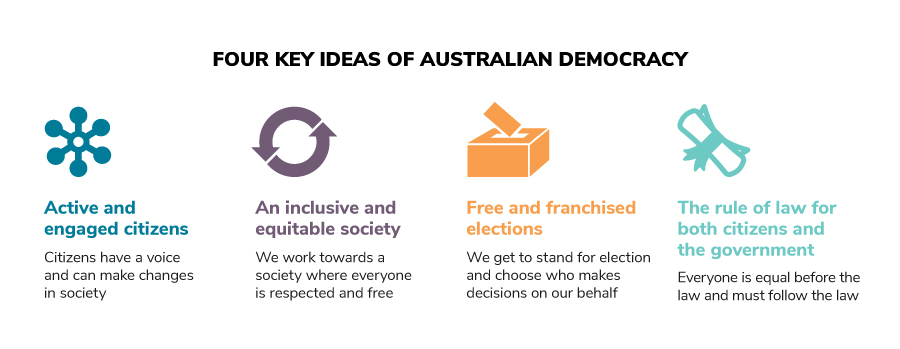
- People have a voice and can make changes in society.
- People can participate by getting involved in their community. This might be by joining a charity, a political party or a community group.
- Everyone can get involved in the work of Parliament through contacting members of parliament, the work of committees, protesting and petitioning.

- People work towards a society where everyone is respected and free, where everyone is valued and supported to reach their full potential.
- People have freedom of speech, association, movement and belief.
- Our society supports the development and well-being of individuals and their right to make their own choices.
- Opposing ideas are tolerated and respected. People listen to different points of view in Parliament and society.

- People can stand for elections and choose who makes decisions on their behalf.
- Voting is done in secret so people can make their choice without pressure or intimidation.
- Elections are run by an independent organisation – the Australian Electoral Commission.

- Everyone is equal before the law and must follow the law, including the people who make laws.
- Laws should be fair, clearly written and protect people's rights.
Retrieved from: Parliamentary Education Office. (2023, October 19). Democracy. Peo.gov.au. https://peo.gov.au/understand-our-parliament/how-parliament-works/system-of-government/democracy
Shared Australian values

Australian values based on freedom, respect, fairness and equality of opportunity are central to our community remaining a secure, prosperous and peaceful place to live. Our values define and shape our country and they are a reason why so many people want to become Australian citizens. Our democratic institutions and shared Australian values have created our peaceful and stable society.
These values are outlined in the Australian Values Statement (AVS) that visa applicants must sign. When you sign the AVS, you acknowledge those Australian values and undertake to conduct yourself in accordance with these values. The aim of the AVS has been to help new residents understand the values that have helped to create a society that is stable and cohesive but, at the same time, dynamic and diverse. The Australian Government has changed the AVS to make it more meaningful and to reflect the importance we place on the values that define and shape our country and culture.
Retrieved from: Australian Government Department of Home Affairs. (2024, February 29). Australian values. Australian Values. https://www.homeaffairs.gov.au/about-us/our-portfolios/social-cohesion/australian-values
Mediating institutions
The infrastructure of Australia’s democratic system consists of a set of institutions and practices that mediate the relationship between the people and the government. Key mediating institutions:
- The federation: state and commonwealth parliaments and bureaucracies
- The courts, the legal system, and accountability institutions
- Political parties
- Unions, religious organisations, interest groups and the voluntary sector
- Cultural institutions
- The information order and communicative infrastructure, including the media Key mediating practices and habits: ● Protest and dissent
- Lobbying, petitioning and letter-writing
- Strategic litigation before the Courts
- Political campaigning
- Universal and compulsory education
- A democratic franchise and compulsory voting
Retrieved from: Histories of Australian Democracy. (n.d.). https://doi.org/10.5281/zenodo.10417730
Anti-discrimination Laws
In Australia, it is unlawful to discriminate on the basis of a number of protected attributes including age, disability, race, sex, intersex status, gender identity and sexual orientation in certain areas of public life, including education and employment.
-
A quick guide to Australian discrimination laws
 Retrieved from: Australian Human Rights Commission. (2023). Australian Human Rights Commission. Australian Human Rights Commission. https://humanrights.gov.au/
 -
Workplace Discrimination - Fair work Ombudsman
 Retrieved from: Fair Work Ombudsman. (2024). Workplace Discrimination. https://www.fairwork.gov.au/sites/default/files/migration/723/Workplace-discrimination.pdf
 -
Get the facts: The Racial Discrimination Act
Retrieved from: Reconciliation Australia. (2014). Australian Human Rights Commission-Racism. It Stops With Me. 2014. https://www.youtube.com/watch?v=_mtw5ZAtbaY 2 Racism. It Stops With Me. -https://www.humanrights.gov.au/our-work/race-discrimination/projects/national-anti-racism-strategy- and-racism-it-stops-me-campaign. https://www.reconciliation.org.au/wp-content/uploads/2021/10/The-Racial-Discrimination-Act-Reconciliation-Australia.pdf

Retrieved from: Australian Unions. (2023, April 13). Know My Rights: Workplace Discrimination Law Changes. YouTube. https://www.youtube.com/watch?v=-L32tZMbSZ
Democratic reform
-
Democratic reform and renewal - Democracy in Australia
 Retrieved from: Healey, J. (2021). Democratic reform and renewal [Chapter 3]. In Democracy in Australia. The Spinney Press. https://search.informit.
org/doi/10.3316/informit.T2024043000031791775361134

Freedom of Speech
Disruption - Annabel Crabb's Civic Duty - S01 E02
In the early days, Parliament House hosted an all-male conclave of politicians and newspapermen, sharing a cramped environment and a complex code of conventions and mutual dependency. But the age of disruption has arrived.
Retrieved from: Annabel Crabb’s Civic Duty S1 • E2 - Disruption. (2019). ClickView. https://clickv.ie/w/WGl4
Retrieved from: Auspol Explained. (2021, August 26). Freedom of Speech in Australia | AUSPOL EXPLAINED. YouTube. https://www.youtube.com/watch?v=h1LTwxe6LGg
Participation
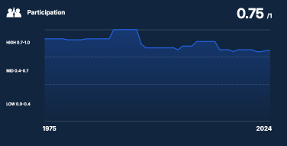
Democracy only works well when citizens are actively involved, not just during elections but also between them.
When people take part in community groups, civic activities, and elections, they help make the government more fair, responsive, and accountable.
Three key parts of participation are:
- Civil Society – community organisations and groups that give people a voice.
- Civic Engagement – citizens taking part in discussions, volunteering, or local decision-making.
- Electoral Participation – voting and getting involved in the election process.
Together, these forms of participation keep democracy strong and connected to the people.
Retrieved from:Australia | The Global State of Democracy. (n.d.). Www.idea.int. https://www.idea.int/democracytracker/country/australia
People Power - Annabel Crabb’s Civic Duty S01 • E03
Democracies operate according to rules, but they also change. Sometimes at the hands of visionary or power-hungry leaders, sometimes in response to external forces, and sometimes as a result of people power.
Retrieved from: Annabel Crabb’s Civic Duty S1 • E3 - People Power. (2019). ClickView. https://clickv.ie/w/9Tl4
-
Getting involved
Retrieved from: Getting involved - Parliamentary Education Office. (n.d.). Peo.gov.au. https://peo.gov.au/teach-our-parliament/education-resources/quizzes/getting-involved
-
Political Engagement in the Australian Digital Context
 Retrieved from: Vromen, A. (2015). Political Engagement in the Australian Digital Context. Aph.gov.au. https://www.aph.gov.au/About_Parliament/Senate/
Publications_and_resources/
Papers_and_research/Papers_on_Parliament_and_other_resources/
Papers_on_Parliament/69/Political_Engagement_in_the_Australian_Digital_Context
Plurality in Australia
Australia’s national identity is best understood through the lens of ‘civic nationalism’, a model that unites citizens not through shared ancestry or culture, but through a commitment to common democratic principles. As Peter Kurti explains in The Ties That Bind, “this model does not require moral consensus, but depends on shared political commitments: to the rule of law, democratic accountability, and the peaceful resolution of disagreement.” People are not required to share the same morals or cultural beliefs. It recognises that Australians will disagree, sometimes strongly, on important issues. What matters is how those disagreements are handled. All citizens are expected to work through differences within a common legal and democratic framework. In Australia, diversity and unity can go hand in hand, but only when there is a shared commitment to the civic values that protect freedom and rights, uphold justice, and allow people from all backgrounds to live together under the same rules.
Retrieved from: Plurality in Australia. (n.d.). https://informed.ruleoflaw.org.au/wp-content/uploads/2025/07/ROL_Informed_Plurality_Factsheet-FINAL.pdf
Recommendations to stop corruption

Retrieved from: Healey, J. (2021). Democratic reform and renewal [Chapter 3]. In Democracy in Australia. The Spinney Press. https://search.informit.org/doi/10.3316/informit.T2024043000031791775361134
Glossary:
Retrieved from: Dictionary.com. (2025). Dictionary.com. https://www.dictionary.com/
-
Parliamentary Glossary
Retrieved from: Glossary - Parliamentary Education Office. (2024). Peo.gov.au. https://peo.gov.au/understand-our-parliament/glossary#A
-
Glossary of Constitutional Terms
Retrieved from: Glossary of constitutional terms. (n.d.). Referendum 2023. https://civicsaustralia.org.au/glossary-of-constitutional-terms/
-
Democracy in Australia - Glossary
Retrieved from: Glossary. (2021). In Democracy in Australia. The Spinney Press. https://search.informit.org/doi/10.3316/informit.T2024043000032000486855303
Major lobby groups in Australia

Minerals Council of Australia: The MCA represents the large mining and resources companies that drive a significant part of Australia’s export economy, and serves as a key lobbying voice for the mining sector. Observers and analysts have identified the MCA as having “the single largest negative influence on Australian climate-related policy,” due to its opposition to stricter environmental regulation and its campaigns to protect mining and fossil-fuel interests.
Business Council of Australia (BCA)
The BCA represents more than 130 of Australia’s biggest corporations, bringing together CEOs from a broad cross-section of sectors to influence national economic and policy direction. It has a major role shaping federal economic policy, including taxation, regulation, industrial relations, and broader economic reform.